
Manufacturing simulation for the production of tomorrow: five trends
The course has already been set: The future of manufacturing is more networked, faster and more digital. The year 2026 will play a decisive role in this development because skilled workers, systems, robots and software will have to be even more closely coordinated. Visual Components, a provider of systems for manufacturing simulation, shows which trends will take center stage.





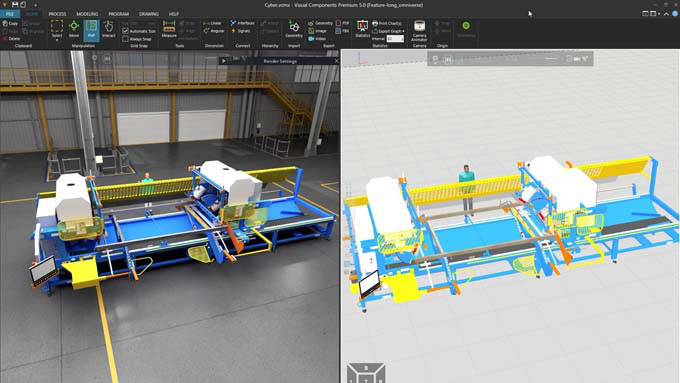
Manufacturing simulation continues to experience a technological upswing. The direction is clear: away from visionary promises and towards demonstrable productivity gains. More digitalization, networked data streams and simulation-supported decisions ensure that production lines can be planned faster, adapted more flexibly and operated more efficiently. With this in mind, Visual Components has identified five key trends that will shape 2026 and prepare production specifically for the requirements of tomorrow:
1. process chains are digitalized end-to-end
Thanks to fully digital processes, data can flow together seamlessly from design to simulation to system control and create a complete picture. This eliminates media disruptions and allows companies to minimize errors, identify bottlenecks in advance and implement adjustments directly. As a result, the production line runs more stably, flexibly and efficiently.
2. job profiles are changing
Work is increasingly shifting from manual activities to digital tasks: Employees program robots, monitor virtual processes and control machines using digital tools. Specialist knowledge will always remain central, but new occupational fields are also emerging between the production line, technology and software.
3. more collaboration takes place in the cloud
Several employees will increasingly work simultaneously on layouts, simulations and processes - across locations and in real time. Knowledge is shared, knowledge silos are dissolved, processes are coordinated more quickly and adjustments are implemented directly without stopping production.
4 AI becomes a tool suitable for everyday use
The number of useful applications of AI is growing and helps, for example, to compare variants of layouts or automation concepts or to make data-based decisions. It supplements expert knowledge, identifies bottlenecks at an early stage and ensures that production lines run faster, more reliably and more economically.
5 Virtual commissioning is on the rise
Before a system is physically running, companies can test the control logic, signals and processes digitally. In this way, errors can be detected at an early stage, commissioning times can be shortened and system downtimes can be avoided.
«Simulation and digital planning are changing the role of skilled workers without replacing them,» explains Matthias Wilhelm, Country Manager DACH at Visual Components. «Instead, we are seeing a shift in work from the workbench to digital planning. Those who map processes end-to-end, use AI in a targeted manner and check processes virtually in advance reduce errors, shorten commissioning times and create production lines that run faster, more flexibly and are more resilient. This is the future of production.»
Source: Visual Components