
ARA Bern reduces nitrous oxide emissions with RTO technology
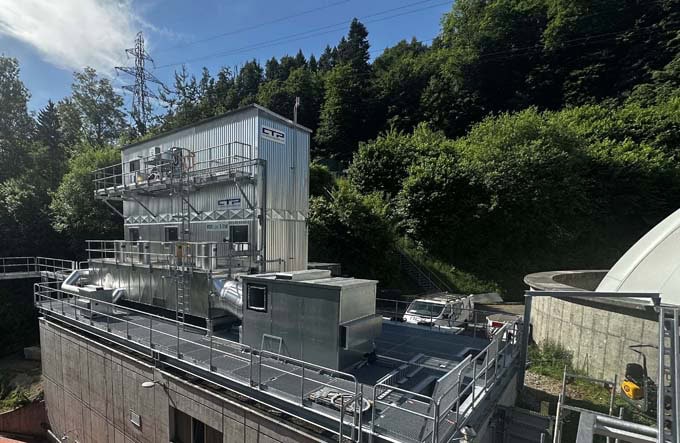
Innovative technology to combat a powerful greenhouse gas: ARA Bern, one of the largest wastewater treatment plants in Switzerland, has been using a regenerative thermal oxidation plant (RTO) from CTP Air Pollution Control GmbH since 2025. This removes over 95 % of the nitrous oxide.





Nitrous oxide is one of the strongest, but often overlooked, greenhouse gas emissions from wastewater treatment plants. It is stable, remains in the atmosphere for over 100 years and has a global warming potential 250 to 300 times higher than CO₂. «The importance of reducing nitrous oxide from wastewater treatment plants is often underestimated, even though these emissions - mainly from the biological treatment stage - make up a significant proportion of the CO₂ equivalent,» says Gerd Rabenstein, COO of CTP Air Pollution Control GmbH from St. Paul im Lavanttal in Austria. For a long time, these emissions went largely unnoticed. But with specific climate targets, the targeted treatment of nitrous oxide is coming into focus.
Customized nitrous oxide solution for ARA Bern
The Bern wastewater treatment plant also released over 10,000 tons of CO₂ equivalents of nitrous oxide (N₂O) in the biological treatment stage and digester water treatment every year - around 80 % of the plant's total greenhouse gas emissions. The commissioning of a regenerative thermal oxidizer (RTO) in August 2025 marked a milestone in the targeted reduction of these emissions. The CTP Air Pollution Control solution allows these emissions to be reduced significantly and economically without affecting the operation of the wastewater treatment plant. Today, N₂O emissions can be almost completely removed from the exhaust air of the biological treatment stage and the digested water treatment with the technology of the air purification specialist CTP - a decisive contribution to the goal of «net zero» in wastewater treatment plants.
RTO systems are considered to be particularly flexible and can be optimized for parameters such as cleaning performance, energy efficiency or pressure loss. The system used in Bern is also a tailor-made solution that has been specially designed to meet the requirements of the wastewater treatment plant. The Bern WWTP uses a version with three ceramic heat accumulators that operate in alternating mode and recover almost all of the heat contained in the exhaust air.
RTO technology: nitrous oxide molecules broken down at high temperature
In the combustion chamber of the RTO system, the nitrous oxide molecules are broken down into their basic elements nitrogen and oxygen at high temperatures. «Catalytic processes reach their limits, as catalysts can be poisoned and only have a short service life,» explains Rabenstein. «With our robust solution, the nitrous oxide is almost completely broken down.» Thanks to the regenerative heat exchangers, the system is also very energy-efficient, and when biogas is used as fuel, operation can even be made climate-neutral.
The high effectiveness of the RTO technology has also convinced independent funding organizations: The Swiss Foundation for Climate Protection and CO₂ Compensation «KliK» is already supporting several projects to reduce nitrous oxide in wastewater treatment plants and recently recognized the RTO plant in Bern as an exemplary model. «This shows that our technology is recognized both in practice and at an institutional level,» says Rabenstein.
Compact plug-and-play version: the «DeNitroBox»
In addition to large systems, CTP also offers a compact plug-and-play solution for smaller exhaust air flows: the DeNitroBox. It is housed in a 20-foot container and enables an N₂O reduction of 90 % with minimal energy consumption. The container solution can be put into operation directly on site, is eligible for subsidies and offers plant operators a low-threshold entry into effective nitrous oxide reduction.

«CTP has been following the issue of nitrous oxide emissions for years and is observing increasing momentum in the market. Countries such as Switzerland and Denmark are already setting initial targets for N₂O reduction. As a technology leader, we can offer our customers a mature technology that has proven itself in numerous applications,» says Rabenstein. With the commissioning of the RTO in Bern and its successful application in other projects, CTP is proving that the long-standing problem of nitrous oxide no longer has to play a role in modern wastewater treatment and that the plants can actively contribute to climate protection.
Source: CTP Air Pollution Control