
Hitoshi Takeda: "If there are no faults, something is wrong"
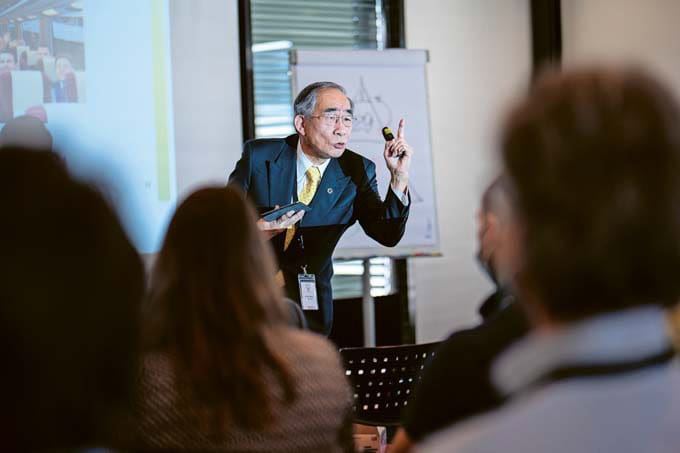
Hitoshi Takeda, a student of Toyota pioneer Taiichi Ono, is considered one of the most important pioneers of modern production systems. His thinking is radical: disruption is not a flaw, but the basis for progress. An interview.





Mr. Takeda, you worked directly with Taiichi Ono. What influenced you the most during this time?
Hitoshi Takeda: Three important lessons: 1. make change a routine! Be prepared for crises, face them every day and use them positively as an opportunity. 2. even small disruptions are important. Only when we stop, look and improve do we develop the ability to master even major crises. 3. always ask yourself whether your company can survive in the future with the current approach. Difficult problems allow people to grow. Restrictions make great creativity possible in the first place: reduce the set-up time from three hours to three minutes. Take away a zero, even if it seems impossible, do it with a tenth of the budget. And think so hard about it that it seems like a dream.
How has the mindset of companies changed in recent decades?
New technologies are increasingly emerging outside of our own expertise. No one will be able to survive alone in the future. In addition, speed is key today. Recalls spread around the world in seconds. If the response is not immediate, this can become a major problem. Development, production and logistics strategies must be geared towards this speed. But speed is also crucial in production: no new idea will be perfect right from the start, and we don't have time to wait that long. Therefore, the following applies: produce, deliver, observe the market's reaction, improve, deliver again. The winners will be the companies that can repeat this cycle the fastest.
Disruption plays a central role in your philosophy. Why is that?
There is no workplace where nothing goes wrong. Problems and disruptions are normal, and they are opportunities for improvement. If there are no disruptions, this only means that the company has not yet recognized them or that they are being hidden; both inevitably lead to a loss of quality.
Are there good and bad faults?
I differentiate between permissible and impermissible waste. Permissible waste arises, for example, when several development paths are pursued in parallel because it is not yet clear where the market is going - sometimes ambidexterity is needed to remain flexible. Inadmissible waste, on the other hand, arises from fleeting mistakes, endless discussions without implementation or decisions that are only based on the fact that someone says something the loudest.
What role does patience play in the improvement process?
It is crucial to build up technologies and people yourself. If you buy in key technologies, you may grow faster in the short term, but you remain dependent. External technology becomes a black box: you cannot develop it further, you cannot repair it, you cannot really use it. ‚Buying‘ means buying time. But without patience in its own learning, a company loses its true strength.
You often talk about psychological traps. What do you mean by that?
Rational decisions are influenced by psychological distortions. I differentiate between: 1. lack of attitude: not wanting to see problems at all. 2. lack of strength: problems are visible, but people overestimate their own abilities and avoid confronting them. And 3. a lack of integrity: ethics and principles are sacrificed in order to survive. Those who understand these distortions and recognize them in good time will open up great opportunities for their company.
What role will artificial intelligence play in the future?
AI will automate processes - from customer meetings to production control and strategy development. Customers will no longer search for products, but will instead be guided by AI recommendations. We will have to adapt our sales strategies so that AI favors our products. But AI must not cause us to stop thinking for ourselves. That's why I recommend digital detoxification, i.e. spending time without a smartphone every day and establishing analog methods that encourage us to think for ourselves.
You still travel tirelessly around the world. What drives you?
For me, it's not just about productivity and turnover. It's about empowering people: Recognizing problems, investigating causes, implementing improvements. When I hear: «Mr. Takeda, we no longer need you; we can now improve ourselves», then I have done my job.

You will be on stage in St. Gallen on December 5 as the keynote speaker at the SAQ anniversary event. What can participants expect?
A good system is more than just technology. It is a reform of consciousness. It starts with «noticing» and «thinking». Then follow: stop, examine, improve, take action, anchor. This series needs to be repeated daily. I will show why it is crucial to recognize disruptions early and how we train employees to outperform their superiors. Not all at once, but brick by brick. Excellence is not a theory, but a lived culture of error. n
Author
Nemanja Novkovic is Head of Marketing at Noventa Consulting in the Rhine Valley. www.noventa-consulting.com